What Is Algorithmic Trading? A Beginner's Guide to Algo Trading
Algorithmic trading uses pre-defined rules to place and manage orders automatically. Here's how algo trading works, its pros and cons, and how to start without code.
In this story
Algorithmic trading is the use of pre-defined rules, executed by software, to place and manage orders automatically. Instead of clicking buttons manually, you define conditions, entry, exit, size, and risk, and a program acts on them the moment the market meets those conditions. It removes emotion and reaction time from execution.
Historically this required programming skill. Today, no-code and natural-language platforms let retail traders describe a strategy in plain English and run it automatically.
What is algorithmic trading, exactly?
Algorithmic trading (or “algo trading”) means automating trade decisions and execution using a set of rules. You specify the logic, for example, “buy when the 50-day average crosses above the 200-day average”, and software monitors the market and submits orders when the conditions are met. No manual clicking is required once the rules are live.
The core idea is consistency. A rule executes the same way every time, regardless of fear, greed, or fatigue. Algorithms are widely used by institutions, but the same principles now apply to retail traders through accessible tools.
How do automated orders and trading bots work?
A trading bot is software that continuously watches market data and executes your rules. It follows a loop: read market data, check whether your conditions are true, and if so, submit an order to a connected exchange through its API. The bot then manages the position, exits, stops, and take-profits, according to the same rules.
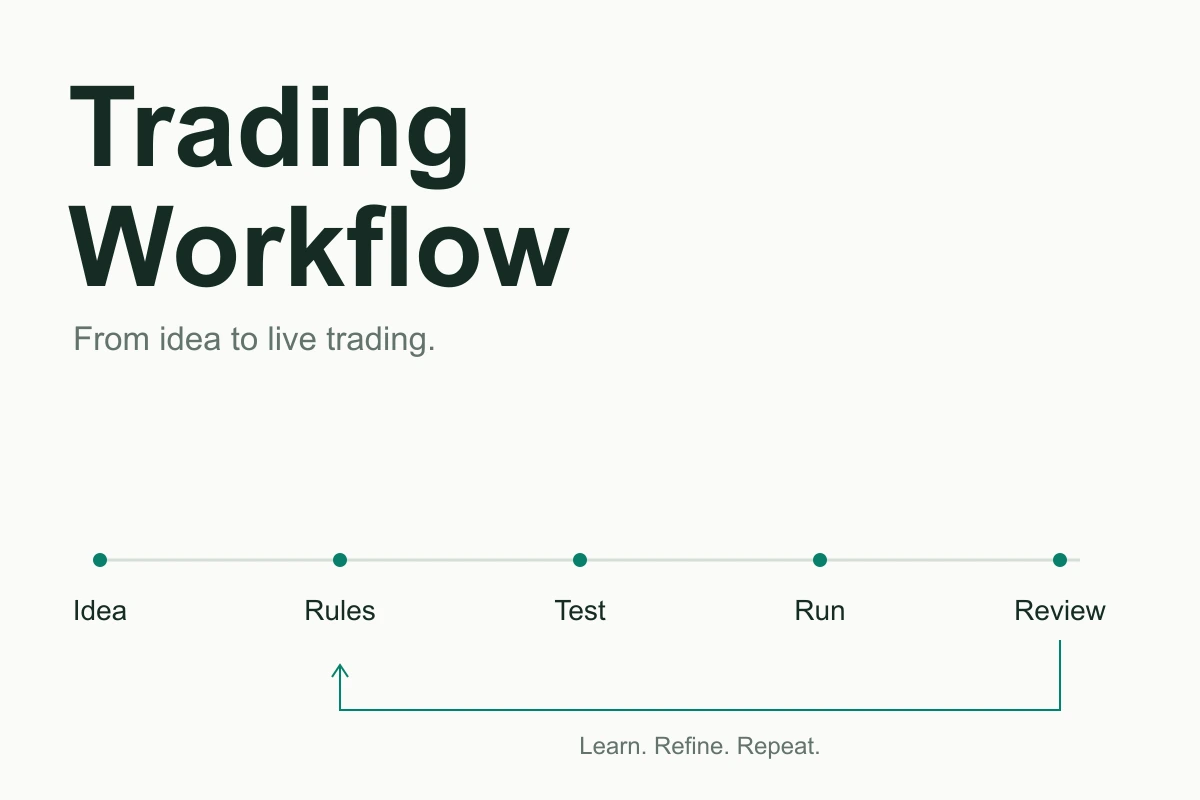
A typical algo trading workflow looks like this:
- Define the strategy — entry, exit, position size, and risk rules.
- Backtest it — run the rules against historical data to see how they would have performed. See how to backtest a strategy.
- Review the metrics — Sharpe ratio, maximum drawdown, and win rate to gauge risk and consistency.
- Go live — the bot generates signals and, with your permission, executes orders on connected venues.
- Monitor and adjust — markets change, so strategies need review.
Order execution relies on order types. A trigger price is a threshold, not a guaranteed fill: when the market reaches your trigger, a market order executes against available liquidity, and the final price can differ from the trigger, especially in fast or thin markets.
What order types can algorithmic strategies use?
Algo strategies are built from order types that define exactly how and when execution happens. Beyond simple market and limit orders, conditional and automated order types let a strategy manage entries, exits, and risk without supervision. Choosing the right order type is central to how a strategy behaves.
| Order type | What it does |
|---|---|
| Market / Limit | Fill now at best price / fill only at a set price or better |
| Stop market / Stop limit | Trigger a market or limit order at a threshold price |
| Take profit market / limit | Close a position once a profit target is reached |
| Trailing stop | Follows price by an activation price + trailing delta |
| OCO | One order cancels the other when one fills |
| Grid | Places layered buy/sell orders across a range |
| TWAP / VWAP | Splits a large order over time to reduce impact |
| Conditional | Fires when a custom condition becomes true |
Reduce Only is a useful safeguard: it forces an order to only close or reduce an existing position, never open a new one. You can explore the full list in the order types docs.
What are the pros and cons of algo trading?
Algorithmic trading offers speed, discipline, and the ability to test ideas before risking capital, but it is not a shortcut to guaranteed profit. Automation executes your logic faithfully, including its flaws, so a poorly designed strategy will lose money efficiently. Understanding both sides is essential.
Pros
- Removes emotion — rules execute the same way in every market condition.
- Speed and availability — bots monitor markets 24/7 and react instantly.
- Backtesting — evaluate an idea on historical data before going live.
- Consistency and scale — manage multiple rules or markets at once.
Cons
- Overfitting risk — a strategy tuned to past data may fail on new data. Backtested results do not guarantee future performance.
- Execution slippage — real fills can differ from trigger or backtest prices.
- Technical and market risk — outages, connectivity, and sudden volatility all matter.
- Leverage amplifies risk — automation does not reduce the risk of loss; leverage increases it.
Trading involves a real risk of loss.
How can retail traders start algo trading without coding?
You no longer need to write code to trade algorithmically. Modern no-code trading platforms let you describe a strategy in plain English, then convert it into an executable, testable system automatically. This lowers the barrier from professional development skill to clear thinking about your rules.
Hey-Traders is a natural-language quant platform built for this. You type a strategy in plain English; its AI converts it into executable code, backtests it on historical data with professional metrics (Sharpe ratio, maximum drawdown, win rate, equity curve), and generates live signals. Once you enable trading permissions, it can execute orders automatically on supported and connected venues, which include major crypto exchanges and prediction markets such as Binance, Bybit, OKX, Hyperliquid, and Polymarket, always subject to venue support and your permissions.
A practical way to begin:
- Start with a simple, well-understood idea rather than a complex one.
- Backtest and read the metrics honestly, focusing on drawdown as much as returns.
- Paper-trade or start small before scaling.
- Use strategy templates to learn common patterns.
Frequently Asked Questions
Is algorithmic trading legal for retail traders?
Yes. Algorithmic trading is legal on most regulated exchanges and is widely used by both institutions and retail traders. You remain responsible for complying with the rules of the venues you connect to and your local regulations.
Do I need to know how to code to start algo trading?
No. No-code and natural-language platforms like Hey-Traders let you describe a strategy in plain English and convert it into an executable, backtestable system automatically, so programming skill is no longer required.
Does backtesting guarantee future profits?
No. Backtesting shows how a strategy would have performed on historical data, which helps you evaluate and compare ideas, but past performance does not guarantee future results. Markets change and real execution introduces slippage.
What is the difference between a trigger price and a fill price?
A trigger price is the threshold that activates an order; the fill price is where it actually executes. Market fills execute against available liquidity, so in fast or thin markets the fill can differ from the trigger.
Ready to turn a plain-English idea into a tested, automated strategy? Explore Hey-Traders to backtest and run algo strategies without writing code, and start small while you learn how your rules behave in live markets.
One last thing
Was this story helpful?
Your perspective helps us improve our guides.
No sign-in needed. An anonymous session remembers your response on this browser. Privacy
A little more perspective.
Crypto Trading Workflow: From Idea to Live Trading
Follow one trading idea from a written hypothesis to tested rules, paper observations, live orders, and the next strategy version.
AI Trading Bot Platforms: How to Choose Trading Software
A bot that can place an order is only part of the decision. Follow one strategy from idea to monitored live execution before choosing an automated trading platform.

Grid Trading Strategy: How Grid Bots Work and When to Use Them
A plain-English guide to grid trading: laddered buy and sell orders across a price range, why grids thrive in ranging markets, their trend risks, and how bots automate the process.