AI Backtesting: Test a Trading Strategy in Plain English
AI backtesting converts a plain-English trading idea into precise rules, runs those rules on historical data, and helps you inspect risk before considering live automation.
In this story
- What an AI backtest looks like in HeyTraders
- What is AI backtesting?
- How does AI backtesting work step by step?
- What does a good AI backtesting prompt look like?
- What should you verify before running the test?
- How is AI backtesting different from traditional backtesting?
- Which AI backtest results should you review?
- How do you stop AI from accelerating overfitting?
- Can ChatGPT or another general AI backtest a strategy?
- When is an AI-backed strategy ready for live automation?
- AI backtesting checklist
- Frequently Asked Questions
AI backtesting uses artificial intelligence to turn a plain-English trading idea into explicit rules, then runs those rules through a historical simulation. The AI accelerates specification and iteration; it should not invent trades or performance numbers. A credible result still depends on clean market data, deterministic execution logic, realistic costs, and out-of-sample validation.
This guide concentrates on the AI-specific workflow — how to move from an ambiguous sentence to an auditable test — while our existing step-by-step backtesting guide covers the broader foundations and data requirements.
If you are choosing the software around that process, our AI trading bot platform guide explains what to look for from strategy creation and backtesting through paper trading, live approval, and monitoring.
What an AI backtest looks like in HeyTraders
HeyTraders returns a workspace you can inspect, not just a written claim about how a strategy performed. This real example shows a multi-asset backtest with BTC, ETH, SOL, XRP and DOGE charts, strategy code, saved runs and test settings in the same view.
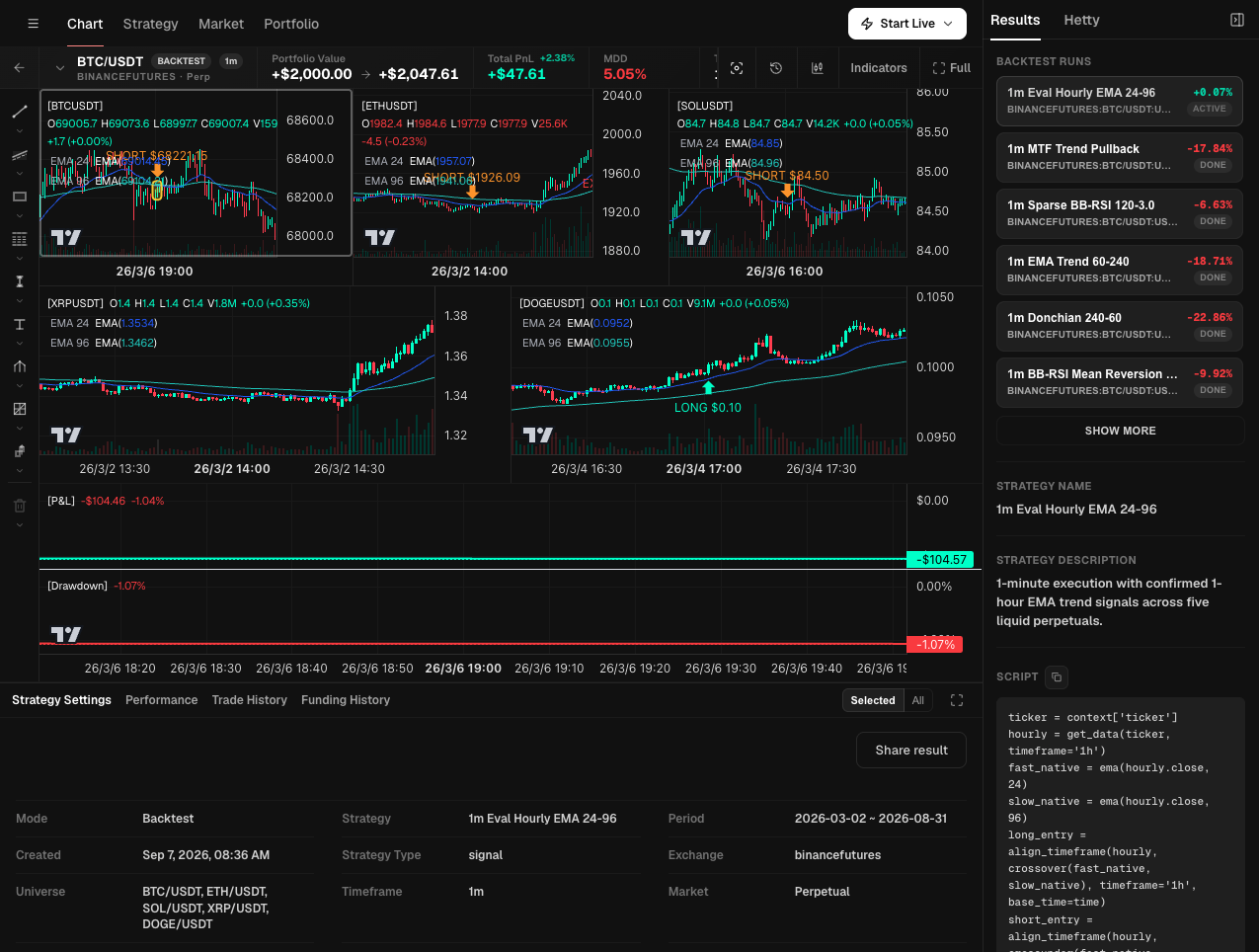
Read the evidence in this order:
- Strategy definition: the right panel identifies the selected strategy and shows the script behind it. Check the rule interpretation before comparing returns.
- Test context: Strategy Settings shows Backtest mode, the venue, timeframe, asset universe and selected period. A chart alone does not specify those assumptions.
- Trade evidence: use the charts and Trade History to investigate signals and trades, then use Performance to examine the aggregate result for the same run.
The pictured description distinguishes one-minute execution from confirmed one-hour EMA signals. That is a useful AI-backtesting review question: did the generated strategy preserve the signal timeframe, or silently turn it into a one-minute indicator? The screenshot shows where to inspect that distinction; it is not an independent audit of the run.
What is AI backtesting?
AI backtesting is a workflow in which an AI system interprets a trading idea, converts it into machine-executable rules, and sends those rules to a backtest engine that simulates historical trades. It lowers the coding barrier, but it does not change what makes a test valid.
The distinction between the AI and the backtest engine matters:
- The AI layer interprets language, identifies missing choices, and produces or revises strategy logic.
- The backtest engine applies that fixed logic to historical data in time order and calculates trades and metrics.
- The trader decides whether the interpretation, assumptions, evidence, and risk are acceptable.
An AI answer that merely describes what might have happened is not a backtest. The performance must be produced by executing the strategy against actual historical observations with declared assumptions.
How does AI backtesting work step by step?
The reliable workflow has seven stages: describe the idea, resolve ambiguity, compile the rules, configure the test, run the simulation, inspect the evidence, and validate on unseen data. Skipping the ambiguity or validation stages makes it easy to produce a polished but misleading result.
- Describe the hypothesis. State the market behavior you want to test, not the return you want to see.
- Make every decision explicit. Define the instrument, timeframe, signal timing, size, entry, exit, and conflict rules.
- Convert the language into executable logic. The AI maps the specification to indicators, comparisons, orders, and position state.
- Review the generated interpretation. Confirm that each phrase became the rule you intended before running anything.
- Configure historical assumptions. Choose dates, starting capital, fees, slippage, funding where relevant, and fill behavior.
- Run and inspect the simulation. Review individual trades as well as aggregate return and risk metrics.
- Validate rather than optimize blindly. Test later, unseen periods and nearby parameter values before considering paper or live trading.
On Hey-Traders, the starting point is a natural-language strategy. The platform converts that description into executable logic, runs the backtest, and returns the result for review. Live automation is a separate decision after the historical evidence has been assessed; it is not an automatic consequence of a good-looking chart.
What does a good AI backtesting prompt look like?
A useful prompt defines the testable choices that materially affect a trade. “Buy Bitcoin when it looks strong” is not testable because “strong” has no single numerical meaning. A better prompt specifies exactly what the engine may know and when it may act.
For example:
On BTC/USDT one-hour candles, enter long at the next candle open after the 20-period EMA crosses above the 50-period EMA on a closed candle. Hold only one position at a time. Risk 1% of starting equity per trade, exit at a 2% stop loss or 4% take profit, and include 0.10% fees plus 0.05% slippage on each side. Test January 2022 through December 2025.
Each phrase has a job:
| Prompt detail | Rule the engine needs |
|---|---|
| BTC/USDT | Exact instrument and data source |
| One-hour candles | Bar interval |
| Closed-candle crossover | Signal uses only completed information |
| Next candle open | Earliest allowed execution time |
| One position at a time | Position and duplicate-entry constraint |
| Risk 1% per trade | Sizing rule, which still needs a stop-distance interpretation |
| 2% stop / 4% target | Exit levels and priority if both could occur in one bar |
| Fees and slippage | Transaction-cost assumptions |
| January 2022–December 2025 | Historical test window |
Even this prompt requires review. “Risk 1%” may mean size the position so the stop equals 1% of equity, rather than invest only 1% of equity. If the platform interprets it differently, the results can change materially. AI should expose that ambiguity, not quietly choose a convenient meaning.
What should you verify before running the test?
Review the compiled strategy as a contract. You should be able to trace every entry and exit back to a written rule and identify what happens when conditions collide.
Check these items first:
- Instrument identity — symbol, venue, contract type, and quote currency.
- Time and timezone — bar interval, session boundaries, and which candle must be closed.
- Entry timing — same close, next open, limit price, or another explicit execution rule.
- Position sizing — fixed quantity, fixed notional, percentage allocation, or risk-based sizing.
- Exit precedence — what happens if a stop and target are both reachable within the same bar.
- Repeated signals — whether the strategy adds, ignores, or replaces an existing position.
- Costs — maker/taker fees, spread, slippage, and funding for perpetual positions.
- Missing data — whether gaps stop the test, skip a bar, or carry forward an old value.
If the result cannot show which interpretation was executed, revise the prompt before judging the metrics. Faster testing is useful only when each test remains reproducible.
How is AI backtesting different from traditional backtesting?
The historical simulation can be the same; the main difference is how the strategy is specified and revised. Traditional workflows require a person to write and maintain code. AI-assisted workflows let the person express intent in natural language and use AI to produce the executable definition.
| Stage | Traditional workflow | AI-assisted workflow |
|---|---|---|
| Strategy input | Code written by hand | Plain-language specification |
| Clarification | Developer interprets requirements | AI identifies or resolves ambiguity with the user |
| Iteration | Edit, test, and debug code | Revise the wording or approved rule set |
| Simulation | Historical backtest engine | Historical backtest engine |
| Responsibility | Researcher validates assumptions | Researcher still validates assumptions |
AI can shorten the distance from idea to first test. It cannot remove the need for market knowledge, careful assumptions, or skepticism. For the wider concept, see natural-language trading; for the underlying automation model, see AI trading explained.
Which AI backtest results should you review?
Start with the equity curve and complete trade list, then evaluate return, drawdown, risk-adjusted performance, and trade quality together. A single headline metric cannot tell you whether the strategy is robust.
At minimum, examine:
- Total and annualized return in the context of the test period.
- Maximum drawdown and the time required to recover.
- Sharpe ratio or another declared risk-adjusted measure.
- Win rate plus average win and average loss, not win rate alone.
- Number of trades and whether a few outliers generated most of the return.
- Turnover and cost sensitivity, especially for frequent strategies.
- Trade-by-trade timestamps and prices to spot impossible or suspicious fills.
- Performance by market regime or time segment, rather than only one aggregate.
Our guide to Sharpe ratio, maximum drawdown, and win rate explains how these measures interact. The important AI-specific check is provenance: confirm that the displayed metrics came from the reviewed rule set and declared run, not from an earlier prompt or configuration.
How do you stop AI from accelerating overfitting?
AI makes it cheap to generate many strategy variants. That is useful for exploration, but it also increases the chance of discovering a configuration that looks good by luck. The more prompts, thresholds, indicators, and date ranges you try, the less convincing the single best result becomes.
The research paper “The Probability of Backtest Overfitting” formalizes this multiple-testing problem: selecting the best in-sample strategy from many trials can produce disappointing out-of-sample performance even when the winning backtest looks strong.
Use these safeguards:
- Write the hypothesis before seeing the result. Do not keep redefining the idea to match the chart.
- Reserve unseen data. Build on one period and evaluate only once on a later holdout period.
- Count every trial. A hundred AI-generated variations are a hundred research attempts, not one.
- Prefer stable neighborhoods. Nearby parameter values should behave reasonably; one isolated optimum is fragile.
- Stress costs and fills. Increase fees and slippage and see whether the result collapses.
- Test different regimes. Include trends, ranges, volatility shocks, and quieter periods where possible.
- Keep rules economical. Each extra filter creates another opportunity to fit historical noise.
Do not ask the AI to “improve the Sharpe ratio until it is above 2.” Ask it to test a defensible market hypothesis under predeclared constraints and report failures as clearly as successes.
Can ChatGPT or another general AI backtest a strategy?
A general-purpose AI can help clarify a strategy, explain metrics, or write backtesting code. It is not a reliable backtest merely because it returns a table of trades or a performance percentage. A credible workflow also needs trustworthy historical data, deterministic time-ordered execution, documented assumptions, and reproducible calculations.
This gives you a simple test: ask where every price, timestamp, fee, and fill came from. If there is no connected dataset and execution engine behind the answer, treat the output as an illustration, not evidence.
A purpose-built AI backtesting platform connects language interpretation to those concrete components. Even then, inspect the generated rules and run configuration. Purpose-built infrastructure reduces manual work; it does not transfer responsibility for the trading decision.
When is an AI-backed strategy ready for live automation?
A strong historical run is the beginning of validation, not the final approval. Move through separate gates so a flaw has multiple chances to surface before meaningful capital is exposed.
- Rule review — every condition and assumption is explicit.
- Historical backtest — performance survives realistic fees, slippage, and multiple regimes.
- Out-of-sample test — the final rule set is evaluated on data not used to design it.
- Paper or observation period — signals run on newly arriving data without normal capital risk.
- Small live deployment — execution, fills, monitoring, and operational behavior are checked with limited exposure.
- 24/7 automation — scale only after defining position limits, pause conditions, and ongoing review.
Hey-Traders supports the path from a plain-English idea to a historical backtest and, after the user separately enables the required permissions, live automated execution on supported venues. Custom Polymarket strategies support Paper and Live modes with incoming market data, alongside separate algo-order controls. Historical Polymarket backtesting is not currently supported, so this article’s historical examples should not be read as Polymarket results. The user remains in control of whether a strategy advances from one gate to the next.
AI backtesting checklist
Before treating a result as decision-useful, confirm that:
- The executed rules match the language you approved.
- The data source, market, timeframe, and date range are visible.
- The test never uses information before it was available.
- Fees, spread, slippage, and relevant funding are modeled.
- Position sizing and concurrent-position behavior are explicit.
- The trade list supports the aggregate metrics.
- All attempted strategy variations are remembered when judging the winner.
- A separate period or forward test is reserved for validation.
- No claim of guaranteed profit is inferred from historical performance.
Frequently Asked Questions
What is AI backtesting?
AI backtesting uses AI to translate a trading idea into explicit, executable rules and then runs those rules through a historical backtest engine. The AI helps with specification and iteration; the result still comes from historical data and simulation assumptions.
Can ChatGPT backtest a trading strategy?
A general chatbot can help describe rules or write code, but a reliable backtest also needs trustworthy historical data, a deterministic execution engine, cost and fill assumptions, and validation. A purpose-built platform connects those parts instead of asking the language model to invent performance figures.
Can I run an AI backtest without coding?
Yes. A natural-language platform can convert a plain-English strategy into executable logic and run the historical simulation. You still need to review the interpreted rules, test assumptions, and results before considering live trading.
What should an AI backtesting prompt include?
Specify the market, timeframe, entry and exit conditions, signal timing, position size, concurrent-position rule, fees, slippage, and test period. If one of those choices is missing, clarify it rather than letting the system guess.
Does a strong AI backtest predict future profits?
No. A backtest measures how one rule set behaved on past data under chosen assumptions. Overfitting, changing markets, liquidity, fees, and live execution can all make future results worse, so past performance never guarantees future returns.
One last thing
Was this story helpful?
Your perspective helps us improve our guides.
No sign-in needed. An anonymous session remembers your response on this browser. Privacy
A little more perspective.
How to Read Backtest Results: Is This Strategy Right for You?
Follow one hypothetical result from an 80% return to its drawdown, recovery time, and trade distribution, then decide what fits your own capital and risk tolerance.
Crypto DCA Backtest for Retirement Planning: Weekly vs RSI and MACD
We earmarked $100 a week for Bitcoin and Ethereum, then compared automatic weekly buying with RSI and MACD filters in HeyTraders.

What Is Backtesting? Why It Matters for Crypto Trading
Turn a trading idea into a testable strategy. Understand the results, the three major biases, and the execution details that change a backtest.