Dollar-Cost Averaging in Crypto: How to Build a DCA Strategy
A practical guide to crypto DCA: understand scheduled Bitcoin purchases, compare new income with lump sums, and define a strategy before automating it.
In this story
- What is dollar-cost averaging in crypto?
- Why do people use DCA?
- DCA with new income is different from splitting a lump sum
- What DCA changes—and what it does not
- A Bitcoin DCA strategy using a fixed weekly schedule
- Is conditional DCA still DCA?
- Three paths after the schedule starts
- Which choices change a DCA strategy?
- What should you measure in a crypto DCA backtest?
- When should you paper trade or go live?
- Turn a DCA idea into a crypto trading bot with Hetty
You want Bitcoin exposure, but every entry feels like a timing decision.
Buy now and the price might fall tomorrow. Wait for a better entry and the market might move without you.
Dollar-cost averaging (DCA) removes that single-entry decision. You buy a fixed dollar amount on a fixed schedule, whether Bitcoin is up, down, or moving sideways.
It can make a plan easier to follow. It does not make Bitcoin less risky, and it does not guarantee a lower average cost.
What is dollar-cost averaging in crypto?
Dollar-cost averaging means investing equal portions at regular intervals regardless of short-term price movement. A weekly Bitcoin DCA strategy could buy $100 of BTC every Monday.
When BTC is lower, the same $100 buys more units. When BTC is higher, it buys fewer. Your average cost comes from the complete price path, not from the schedule alone.
The schedule answers when to deploy the next contribution. It does not answer whether Bitcoin is fairly priced, whether it belongs in your portfolio, or whether the market will rise next year.
For a worked BTC and ETH comparison with indicator filters, see our crypto DCA backtest. This guide focuses on how to design the underlying DCA strategy.
Why do people use DCA?
DCA is useful when the alternative is waiting for a perfect entry, changing your plan after every headline, or investing only when you feel confident—which is usually after the price has already moved.
A fixed schedule gives you a repeatable decision. You know the amount, the date, and the action before the next price move arrives.
That is the main benefit: less entry-timing concentration and fewer decisions to make. It is a process advantage, not a prediction advantage.
DCA with new income is different from splitting a lump sum
The word DCA covers two different situations.
Money arriving over time
You receive $100 from each paycheck and invest it when it arrives. There was no larger balance available on the first day, so the schedule is simply how new savings enter the market.
A lump sum held in cash
You already have $5,200, but choose to invest $100 each week for a year. The rest remains in cash while you wait for the next purchase date.
The second approach reduces the risk of committing everything at one price, but it also delays exposure. Vanguard’s cost-averaging research found that investing an available lump sum immediately often produced higher terminal wealth in its traditional-market study because the money spent more time invested. That is not a crypto forecast; it is the opportunity cost of holding cash.
So the first question is not “is DCA better?” It is: was the money available at the start, or did it arrive along the way?
What DCA changes—and what it does not
DCA changes the timing of purchases. It can reduce the chance that one entire contribution is made at a short-term peak and can make it easier to keep following a plan during volatility.
It does not change:
the market risk of the asset;
the possibility of a long decline or permanent loss;
fees, spread, slippage, custody, or exchange risk;
the opportunity cost of keeping planned contributions in cash;
whether the total allocation fits your time horizon and finances.
A lower average entry during a decline does not mean the account is profitable. The price can keep falling while the schedule continues to buy.
A Bitcoin DCA strategy using a fixed weekly schedule
Here is one complete BTC spot example. The numbers make the strategy testable; they are not a recommendation or a return forecast.
Decision | Illustrative rule |
|---|---|
Market | BTC/USDT spot on one selected exchange |
Schedule | Buy every Monday at 12:00 UTC |
Amount | $100 of quote currency per scheduled purchase |
Horizon | 52 weekly purchases, then review |
Signal | None; buy regardless of the weekly close |
Budget | Maximum $5,200; no extra buy after a price drop |
Execution | Submit one order after the scheduled timestamp and record the actual fill |
Exit | No automatic exit in this accumulation example; define selling or rebalancing separately |
The schedule is the strategy. It needs enough detail to answer practical questions: which clock is used, how do you prevent the same week from being bought twice, what happens after a failed order, and when does the plan stop?
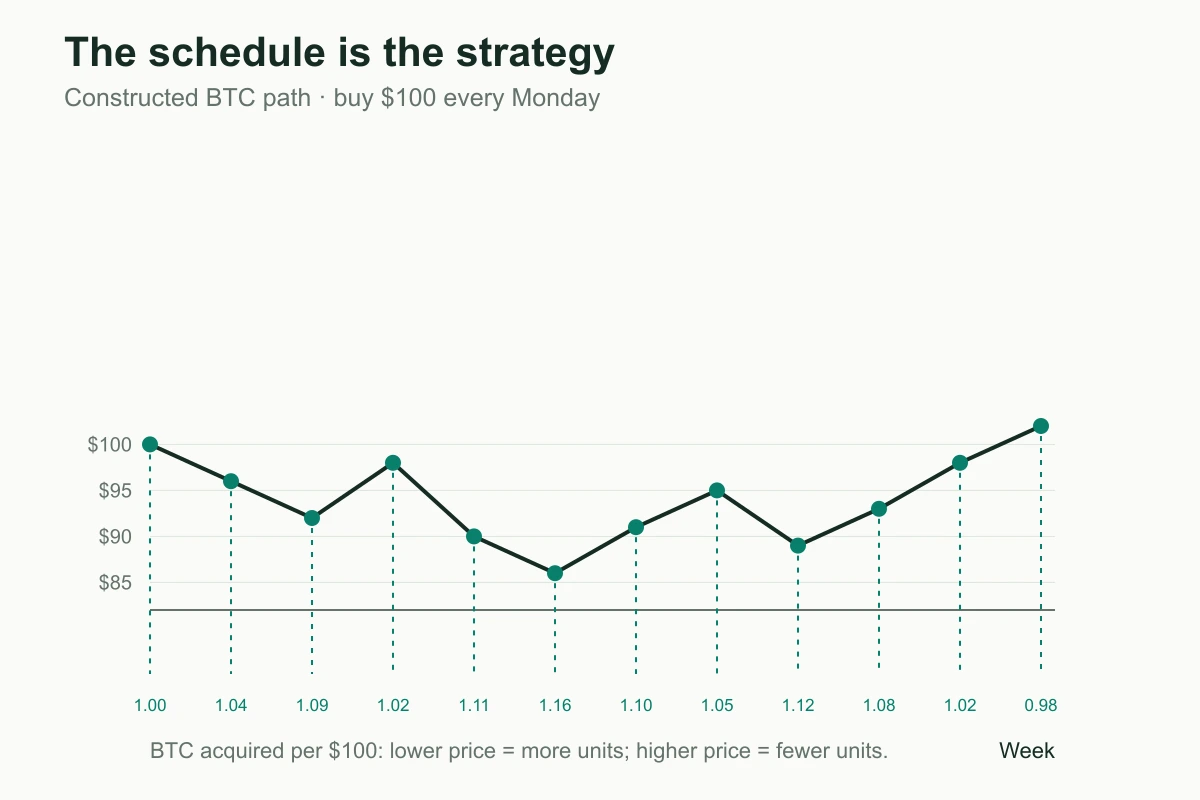
Constructed prices and purchases. The visual explains the schedule; it is not a historical return result.
The crypto trading bot guide explains how a bot turns rules into repeatable actions. A DCA bot adds a calendar and a budget to that workflow.
Is conditional DCA still DCA?
The baseline buys every week. Many strategies use “DCA” while adding a condition:
buy only when weekly RSI is below 40;
buy after a 10% drawdown;
buy when the MACD histogram is positive;
increase the amount after a decline.
These are valid ideas to test, but they change the schedule and the amount of cash deployed. A skipped contribution needs a policy: keep the cash, buy later, use another asset, or cancel the contribution.
Once a price condition decides whether to buy, you are testing a conditional contribution strategy, not the same thing as unconditional DCA. Keep the two baselines separate when comparing results.
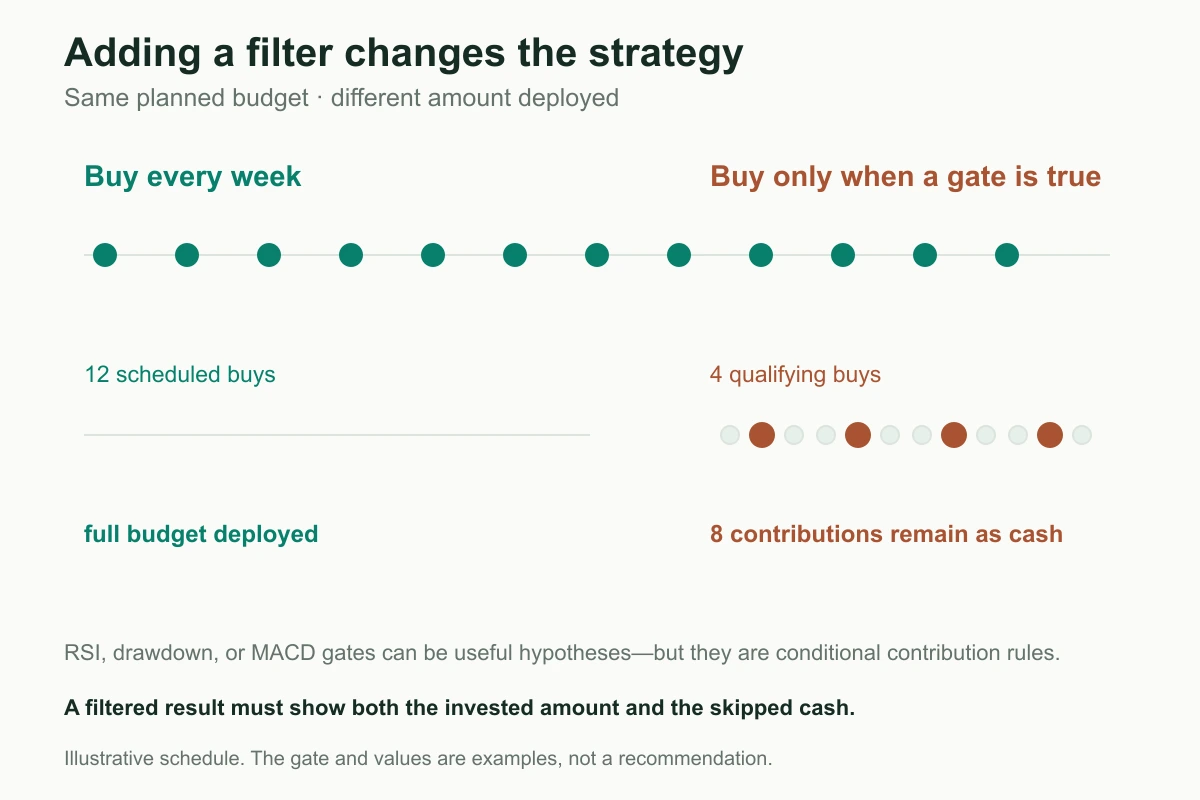
Illustrative schedule. A filtered result should show both the amount invested and the skipped cash.
Three paths after the schedule starts
A rising market
Each purchase happens at a higher price than the previous one. If the whole budget was available on day one, holding part of it in cash would have reduced exposure during the rise. If the money arrived from future income, there was no earlier balance to invest.
A prolonged decline
The schedule buys more BTC as the price falls, lowering the average purchase price. The account can still be deeply underwater if the decline continues or the asset does not recover. DCA does not create a floor.
A sideways market
The schedule buys more units on lower weeks and fewer on higher weeks. The average entry can benefit from that path, but repeated small orders make fees, spread, minimum order sizes, and failed fills more important.
The same DCA rule can therefore feel calm in one path, painful in another, and uneventful in a third. The interval and budget determine how much of each path the account experiences.
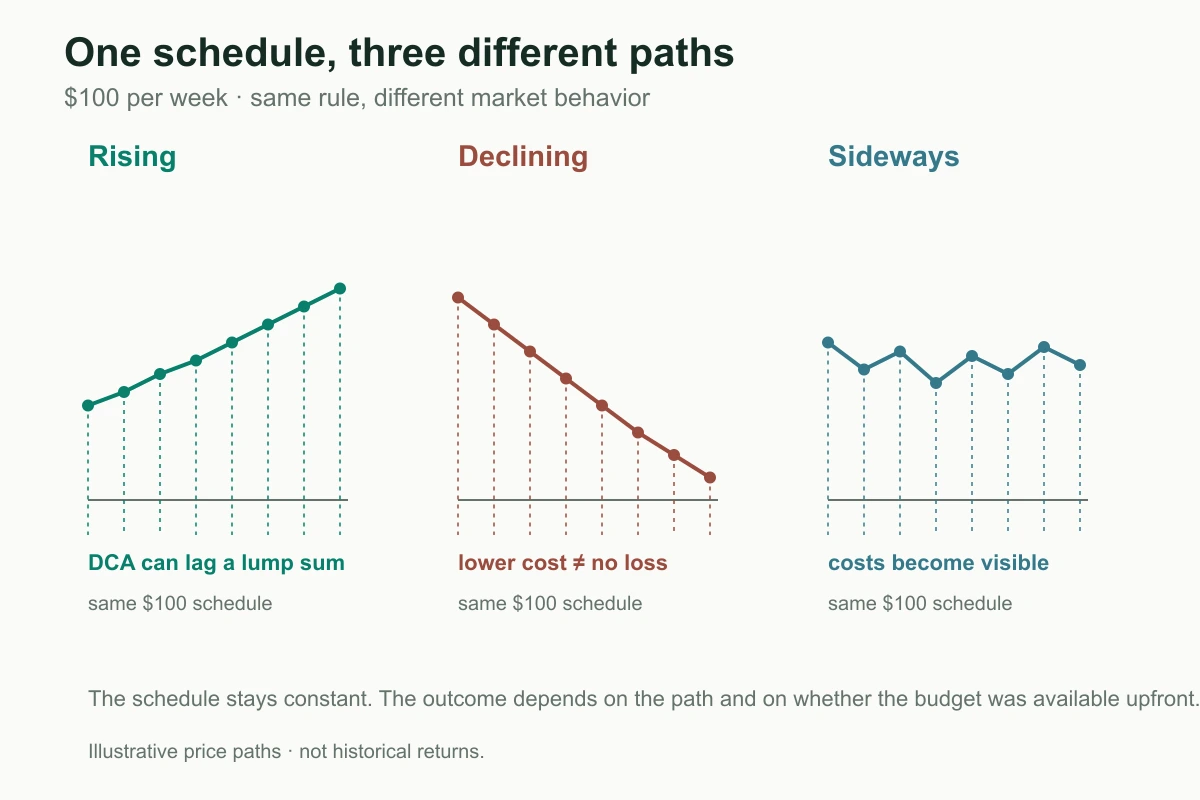
Illustrative paths. The notes describe the trade-off in each environment, not a performance forecast.
Which choices change a DCA strategy?
The interval
Daily, weekly, and monthly schedules expose different amounts of cash to each short-term move. A shorter interval spreads timing more finely but creates more orders. A longer interval creates fewer orders but concentrates each contribution at one timestamp.
The amount and budget
“Buy regularly” is incomplete without a maximum. Define the amount per purchase, the total planned budget, and what happens to unused cash after a missed or skipped order. A price decline should not silently turn a fixed schedule into unlimited averaging down.
The asset mix
Buying BTC and ETH on a schedule creates a portfolio rule. Define the amount per asset, target weights, and whether the plan rebalances. Correlated assets can still fall together.
The execution time
Crypto trades around the clock. Choose a timezone and timestamp, then use the same convention in the backtest and live system. The price at the scheduled time is not guaranteed; an order may fill later or partially.
The exit
A DCA accumulation plan does not automatically define when to sell. A target allocation, scheduled rebalance, risk limit, or separate exit strategy can be added, but each creates another rule to test.
What should you measure in a crypto DCA backtest?
DCA is a schedule of contributions rather than a sequence of conventional entry-and-exit trades. A win rate is not the main question.
Track:
Total contributions: how much the plan intended to invest.
Amount invested: how much actually filled.
Units and average cost: what the schedule accumulated after costs.
Ending value: the assets plus any remaining cash at the test date.
Drawdown: how far the whole plan fell from its previous peak.
Costs and missed orders: fees, spread, slippage, minimums, partial fills, and unavailable timestamps.
The backtesting guide explains how to keep historical decisions in time order. For DCA, keep the contribution and cash record visible too. If a filter skipped most of the planned buys, a high return percentage on the small amount invested does not describe the full savings plan.
Compare the schedule with the right benchmark. If all funds were available at the beginning, include a lump-sum alternative. If contributions arrived from income, compare with the same arrival schedule. Do not mix those two experiments into one percentage.
Backtesting estimates how one contribution rule behaved on one historical sample. It cannot guarantee that the next purchase will improve your average cost or that Bitcoin will recover.
When should you paper trade or go live?
Paper trading a DCA strategy is useful for checking the calendar, duplicate prevention, order status, partial fills, and budget accounting. It also shows how the position behaves during a decline before real capital is involved.
When those mechanics and the drawdowns fit your situation, you can decide whether to move to live trading at a contribution size you can tolerate. There is no universal number of weekly purchases that makes a DCA plan ready.
Turn a DCA idea into a crypto trading bot with Hetty
You can describe the schedule, budget, asset mix, and failure handling in plain English, then inspect the rules before testing them.
Build a BTC/USDT spot DCA strategy. Buy $100 every Monday at 12:00 UTC for 52 weeks. Use no price or indicator filter. Set a maximum planned contribution of $5,200, submit at most one order per scheduled week, and record actual fills, fees, partial fills, and missed orders. Keep unused cash separate. Show me the rules and cash-flow accounting before backtesting.
DCA is simple to state, but the details determine what the account actually does. Define the schedule, the budget, and the cash policy before automating the next purchase.
One last thing
Was this story helpful?
Your perspective helps us improve our guides.
No sign-in needed. An anonymous session remembers your response on this browser. Privacy
A little more perspective.
Mean Reversion in Crypto: How to Build a Strategy
A practical guide to mean reversion in crypto: define the reference mean, build a BTC example, and test what happens when the rebound never arrives.
Momentum Trading in Crypto: How to Build a Strategy
Why buy after a move begins? Follow a Bitcoin Donchian breakout example through entry, exit, false starts, and the choices that shape your strategy.
Polymarket Trading Strategy: How to Automate It
Combine outside data like weather forecasts or Binance prices with Polymarket order rules—then inspect the generated DSL before running it.