What Is a Crypto Trading Bot? How Automated Trading Works
From recurring purchases to custom strategies, learn what a crypto trading bot can automate and what to define before running one.
In this story
Crypto markets run around the clock. Following a trading strategy can mean waiting for an entry, checking several assets, placing orders, and managing positions—even when you would rather be doing something else.
A crypto trading bot automates those tasks. It monitors market data and places orders according to rules you define.
You might automate a recurring BTC purchase, the exit from an existing position, or a strategy that manages entries and exits across multiple assets. The starting point is deciding which part of your trading process you want software to handle.
What is a crypto trading bot?
A crypto trading bot is software that monitors market conditions and places or manages orders using predefined logic.
Automated trading is the process. A trading bot is the software that carries it out.
The rules determine what the bot does: which assets it watches, what triggers a trade, how much it buys or sells, and when it exits.
Bots typically connect to crypto exchanges through an API—a connection that allows software to retrieve market data, check positions, and submit orders without someone clicking through the exchange interface.
Depending on the platform, you can create those rules by writing code, configuring settings, or describing your idea to an AI assistant.
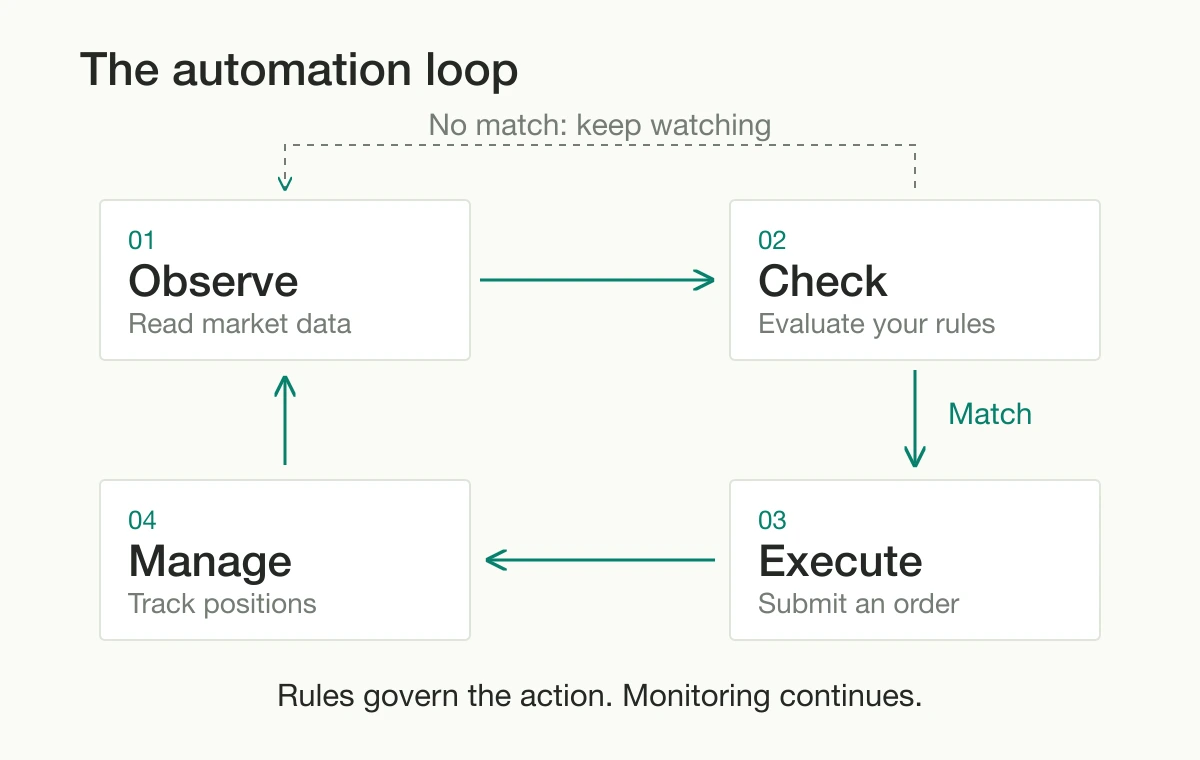
The bot keeps monitoring. A check only leads to an order when the rules permit it.
Why do traders automate crypto trading?
Automation changes how much of a strategy depends on your continuous attention.
Monitor markets without watching every chart
A trading setup can involve a long wait before its conditions are met. Checking the chart repeatedly is part of the work, even when no trade occurs.
A bot can perform those checks while you research another idea, work, or sleep. In a market that never closes, this makes it possible to follow a strategy beyond the hours you are personally available.
Apply your rules consistently
A strategy might tell you to exit when a trend weakens or reduce exposure when positions become too large.
Executing those decisions manually requires you to recognize the condition and respond each time. A bot makes that response part of the trading process.
You still choose the rules and decide when to revise them. Automation handles their repeated application.
Follow multiple assets
A condition that is easy to check on one chart becomes more demanding across several markets.
Bots can monitor supported assets, check existing positions, and apply allocation limits before submitting another order. This lets you expand the scope of a strategy without manually repeating every check.
Coordinate entry and position management
A trade involves more than opening a position. You may also need an exit rule, a limit on additional entries, or a condition that pauses new trades.
Automation connects those actions. Instead of remembering each step after an entry, you define how the position should be managed beforehand.
What can you automate?
You can begin with a single task or automate a complete strategy.
A recurring action
For example, buy a fixed amount of BTC each week or rebalance a portfolio when allocations move beyond a chosen threshold.
These tasks follow a schedule or a condition that can be checked repeatedly.
Part of a trade
You can choose an entry yourself and automate what happens afterward.
That might mean taking profit at a target, submitting an exit when a stop condition is reached, or moving a trailing stop as the price changes.
This approach lets you retain discretion over the entry while automating position management.
A complete set of trading rules
A bot can also monitor your entry conditions, open a position, manage it, and exit.
The rules might use price trends, deviations from a reference level, volume, or other supported inputs. They can apply to one asset or several.
These are examples rather than a fixed menu. What you can automate depends on both your rules and the platform’s ability to express and execute them.
When evaluating a platform, look beyond the name of the bot. Check whether it supports the data, conditions, order types, and position controls your idea requires.
Common crypto trading bot strategies include momentum trading to follow trends, mean reversion to trade potential moves back toward a reference level, dollar-cost averaging (DCA) for scheduled purchases, and grid trading for orders across price levels. Other approaches include pairs trading based on the relative performance of two assets, arbitrage to target price differences between markets, and portfolio management to automate allocations, rebalancing, and exposure limits. These are examples—you can also combine rules into a custom strategy.
How does a crypto trading bot work?
Consider a simple illustrative strategy:
Check BTC every hour. If its price moves above a specified trend indicator, buy $100 worth. Hold only one position at a time, and exit when the price moves back below that indicator.
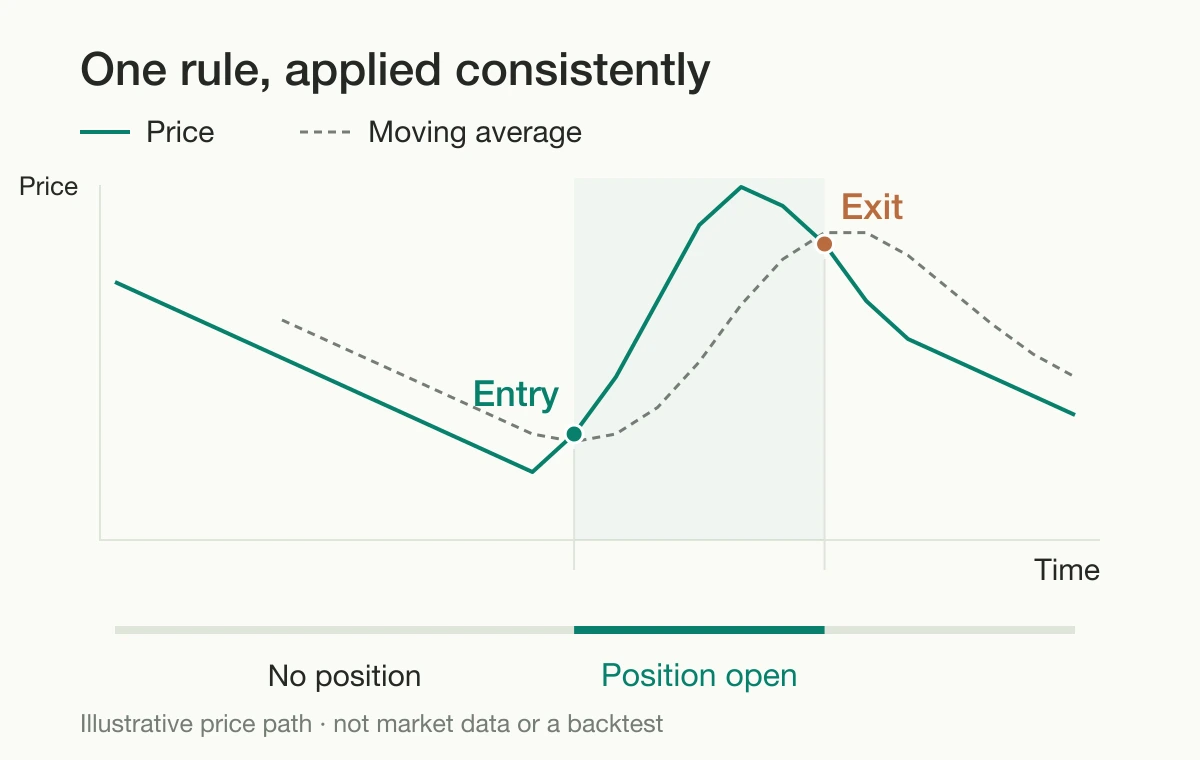
An illustrative moving-average rule: enter after a cross above, exit after a cross below. This is a schematic example, not market data or a backtest.
The bot turns that instruction into a repeating process.
Observe → Check → Execute → Manage
1. Observe the market
It retrieves the market data needed to evaluate the indicator.
2. Check the rules
It checks whether the entry condition has occurred, whether a position is already open, and whether sufficient capital is available.
A signal does not automatically mean another purchase: the position and allocation rules also have to permit it.
3. Execute the trade
If the conditions are satisfied, the bot submits an order to the exchange and tracks the result.
An order may fill, partially fill, remain open, or be rejected. The execution system needs to account for what actually happened.
4. Manage the position
Once the entry fills, the bot monitors the exit condition. When that condition occurs, it submits the exit order and tracks it.
The same basic process can support many different strategies.
What should you define before running a bot?
A useful trading idea needs enough detail for software to act on it.
“Buy BTC when it looks strong” leaves several decisions open. Which measure defines strength? How much should the bot buy? What happens if you already hold BTC?
Before building, answer these questions:
| Decision | What to define |
|---|---|
| Market and data | Which assets, exchanges, and inputs will the bot use? |
| Entry and exit | What conditions open and close a position? |
| Capital allocation | How much can each trade use, and how much can the strategy use overall? |
| Position limits | Can it add to an existing position? How many positions can it hold? |
| Execution | Which order types will it use, and what should happen if an order does not fill? |
| Pause conditions | When should the bot stop opening new trades? |
These decisions determine the behavior you are asking the bot to automate.
Account for execution costs
Fees, spreads, and slippage affect the result of a strategy. A signal price is not necessarily the price at which an order fills, and an exit trigger does not guarantee a particular execution price.
This matters especially when a strategy trades frequently or operates in less liquid markets.
Test the rules
Backtesting applies your rules to historical data. It helps you inspect the trades, returns, and drawdowns the strategy would have produced under the test’s assumptions.
Paper trading then lets you observe the strategy as new market data arrives, using simulated funds.
Together, these steps help you check whether the implementation behaves as intended before committing real capital. Neither guarantees future performance.
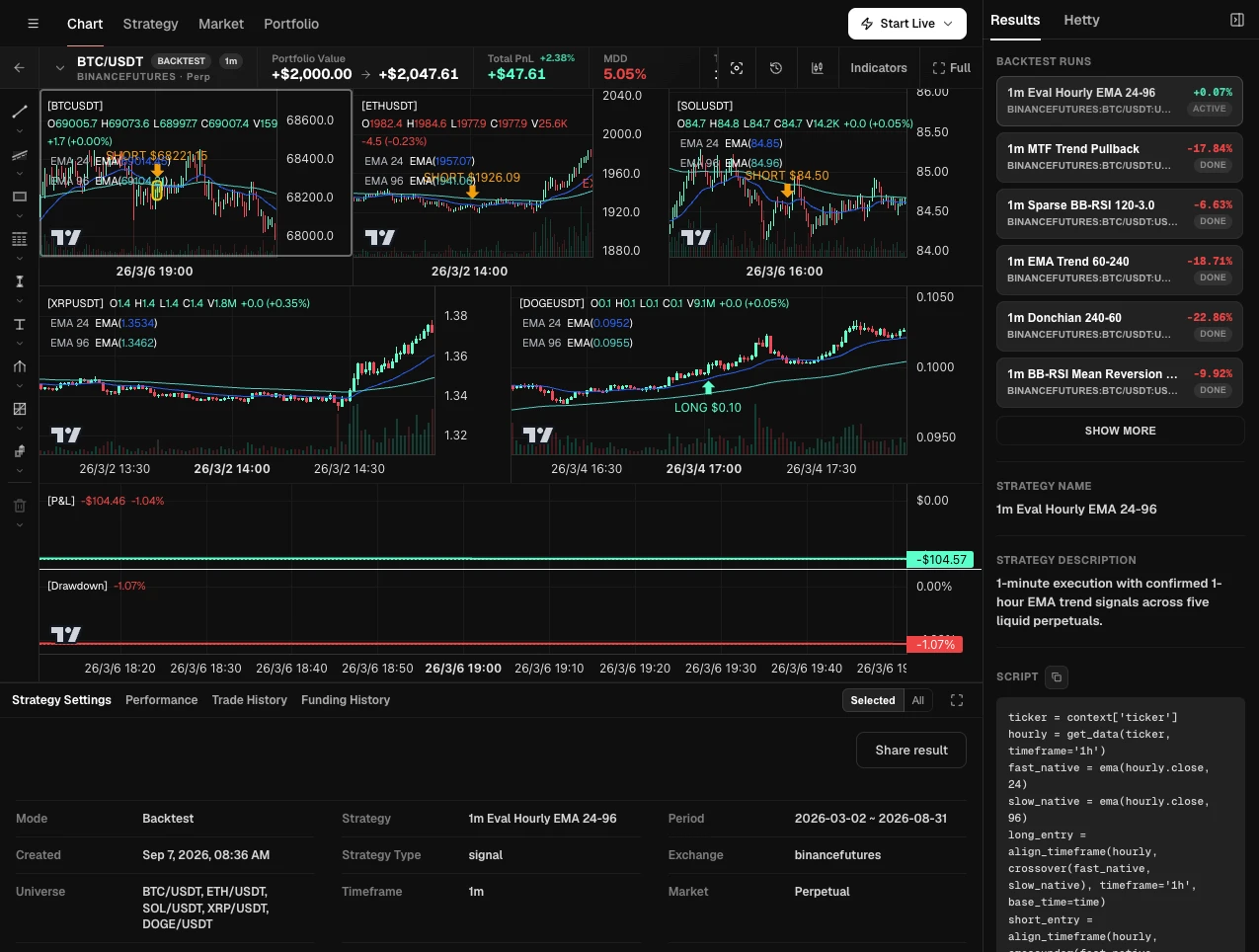
A HeyTraders backtest workspace. Inspect the strategy, test settings, and individual trades together. This screen shows historical simulation, not live trading.
Keep visibility into the live bot
Once a bot is running, you should be able to see its orders, positions, available capital, and errors.
Exchange connections can fail, orders can be rejected, and market conditions can change. Monitoring tells you whether the bot is operating as intended and whether its rules still fit your trading plan.
Turn your trading idea into an automated strategy
Start with something you already know how to describe: a condition you watch, an action you repeat, or a position-management rule you want to follow.
Make the conditions explicit, choose the allocation and limits, and test the resulting behavior.
With HeyTraders, you can describe that idea to Hetty, develop it into a strategy, backtest it, and move through paper and live trading.
What is the first part of your trading process you would like to automate?
One last thing
Was this story helpful?
Your perspective helps us improve our guides.
No sign-in needed. An anonymous session remembers your response on this browser. Privacy
A little more perspective.
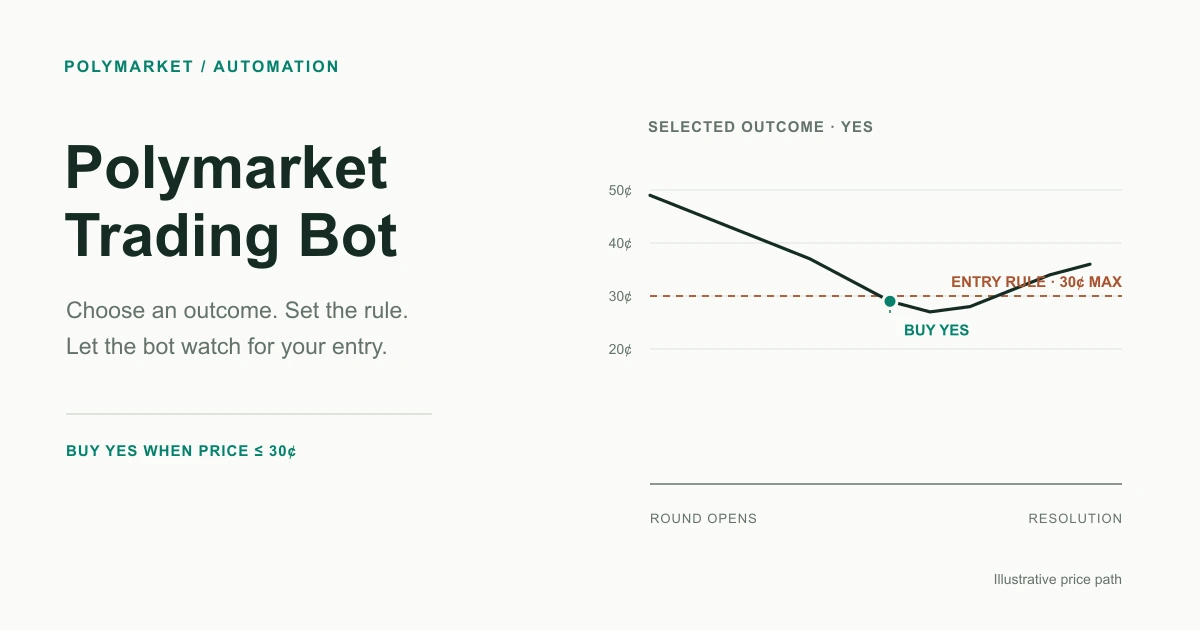
Polymarket Trading Strategy: How to Automate It
Combine outside data like weather forecasts or Binance prices with Polymarket order rules—then inspect the generated DSL before running it.
Dollar-Cost Averaging in Crypto: How to Build a DCA Strategy
A practical guide to crypto DCA: understand scheduled Bitcoin purchases, compare new income with lump sums, and define a strategy before automating it.

Mean Reversion in Crypto: How to Build a Strategy
A practical guide to mean reversion in crypto: define the reference mean, build a BTC example, and test what happens when the rebound never arrives.