Crypto Trading Workflow: From Idea to Live Trading
Follow one trading idea from a written hypothesis to tested rules, paper observations, live orders, and the next strategy version.
In this story
- What is a trading workflow?
- 1. Start with a trading hypothesis
- 2. Turn the idea into rules
- 3. Backtest the version you intend to run
- 4. Observe the strategy in paper trading
- 5. Make a live deployment plan
- 6. Monitor behavior as well as performance
- 7. Review and develop the next version
- Build the workflow around your own idea
You see a trading opportunity: BTC has been trending upward, and you want to buy when momentum strengthens and exit when it fades.
To trade that idea consistently, you need to decide what counts as momentum, how much capital to use, and what should happen after an entry. Then you need to test the rules and see how they behave as new market data arrives.
A trading workflow connects those decisions. It gives you a practical way to move from an observation on a chart to a strategy you can run, monitor, and improve.
What is a trading workflow?
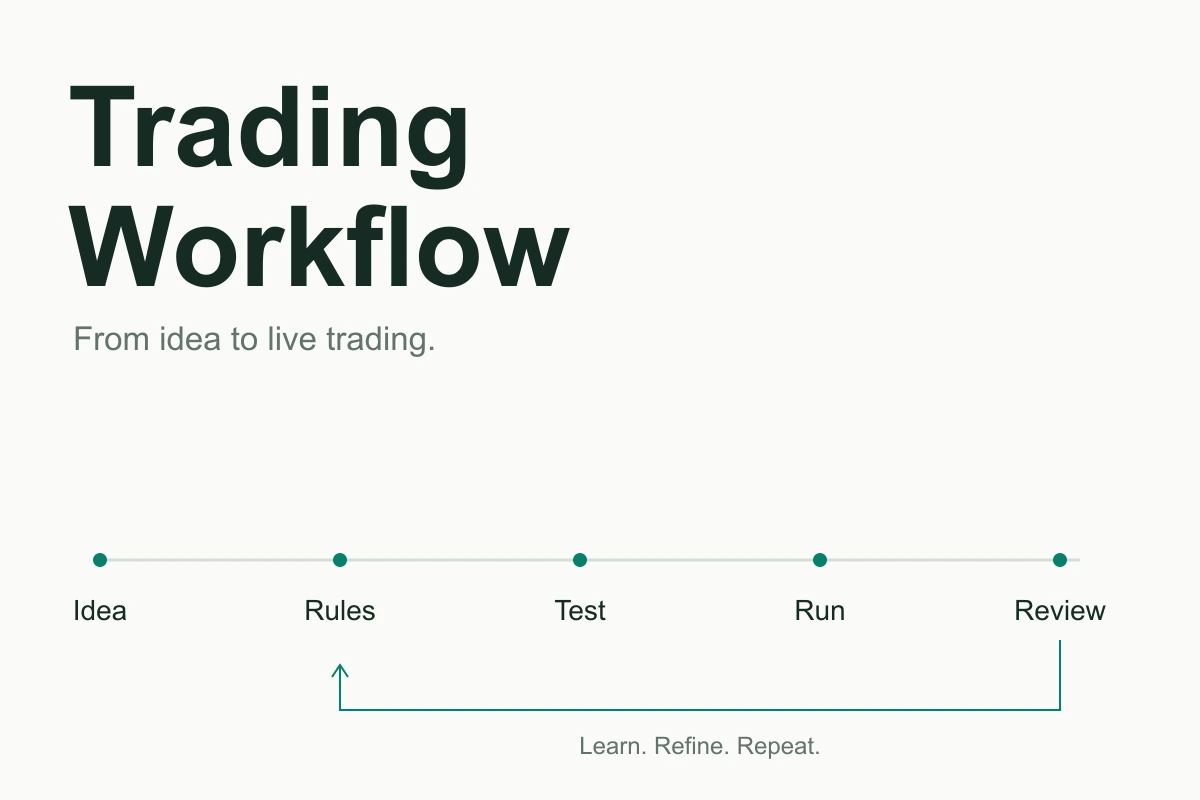
A trading workflow is the process you use to research an idea, define its rules, evaluate it, execute it, and review the results.
For an automated crypto strategy, the sequence usually looks like this:
Idea → Rules → Backtest → Paper trading → Live trading → Review
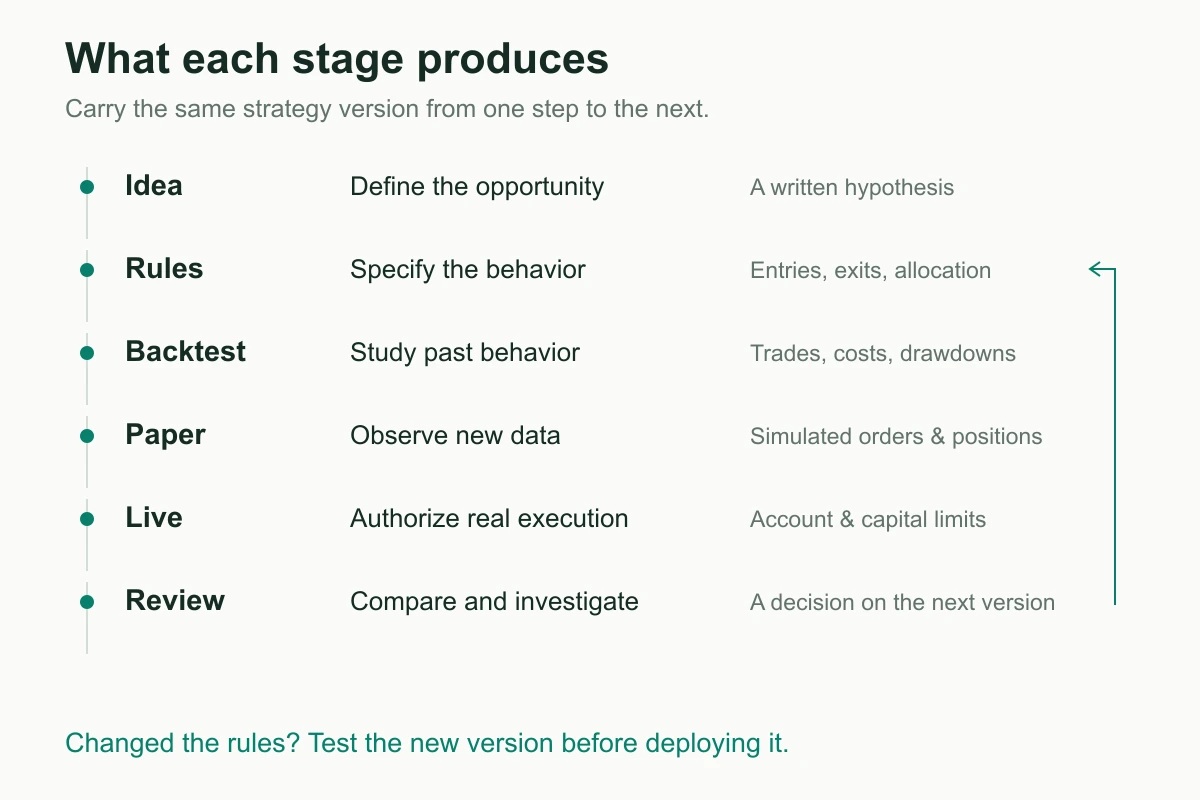
Each stage answers a different question. Research explains the opportunity you want to pursue. Testing shows how your rules behave. Live operation introduces actual orders and fills. Review helps you decide what to keep, change, or stop.
A crypto trading bot carries out the parts you automate. You still choose the strategy, its allocation, and when to revise it.
1. Start with a trading hypothesis
Begin with the behavior you expect to trade and a reason for expecting it.
For example:
When BTC moves into a sustained upward trend, buying a confirmed move above a trend measure may capture part of that continuation.
That gives you a hypothesis to investigate. You can look for periods when trends continued, periods when they quickly reversed, and the conditions surrounding both.
Other ideas might involve buying at regular intervals, trading a price deviation, or rebalancing assets when their weights change. Your workflow can start with an action you already repeat manually.
Write down three things:
The behavior: what opportunity are you trying to capture?
The market: which asset, venue, and instrument does the idea concern?
The horizon: how frequently should decisions be made, and how long might positions remain open?
These choices keep the later test connected to the original idea.
2. Turn the idea into rules
An executable strategy needs instructions for the whole position, including what happens when nothing should be done.
For our BTC example, an initial specification could be:
Decision | Illustrative rule |
|---|---|
Market | BTC spot on one selected exchange |
Signal | Evaluate completed hourly candles |
Entry | Buy when the close crosses above its 50-hour moving average |
Exit | Sell when an hourly close falls below the moving average |
Allocation | Use 10% of available cash for an entry |
Position limit | One open position; no additional purchases while holding |
Execution | Submit a market order after the condition is confirmed |
These are example settings, not a recommended strategy or allocation.
The position limit is as important as the entry. Without it, “buy above the moving average” could mean a new purchase every hour that BTC stays above it. A crossover condition and a check for an existing position make the intended behavior explicit.
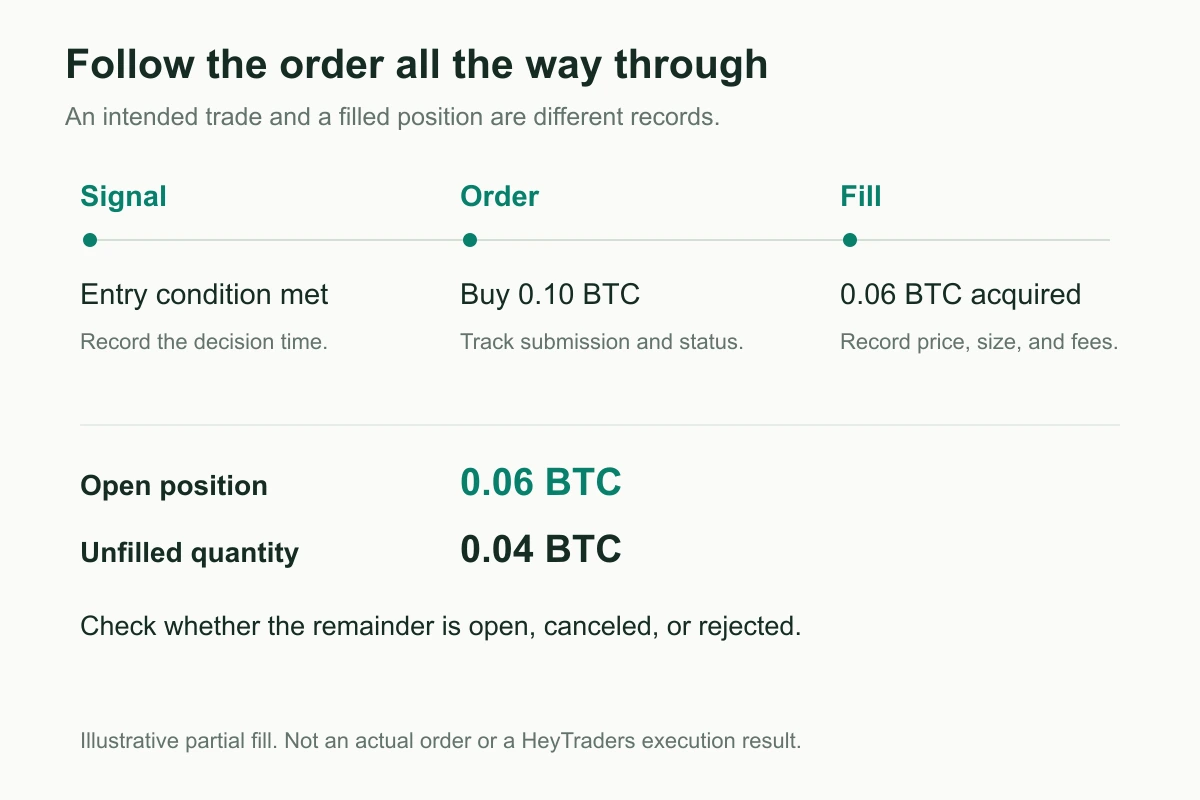
Also decide how to respond when an order does not fully fill. The next action should reflect the position actually acquired, rather than the quantity originally requested.
Save this specification as your first version. It becomes the reference for the test and any later changes.
3. Backtest the version you intend to run
Backtesting applies the rules to historical data. Start by checking that the simulated entries, exits, and position sizes match your specification.
Then look at what following those rules involved:
How frequently did the strategy trade?
How deep and long were its drawdowns?
How much did costs affect the result?
Did returns come from a few trades or a wider set of opportunities?
How did it behave in trending and sideways periods?
For the BTC example, a useful question is whether repeated entries and exits during choppy periods consumed the gains from sustained trends.
If you change the moving-average length or add a filter, record the change and its purpose. Keep data aside for evaluation that was not used to choose the settings. Repeatedly tuning against the same history can produce an impressive result that depends on that history’s noise.
Keep the strategy version, test period, and assumptions together. A result from one set of rules should not become the justification for deploying a different set.
4. Observe the strategy in paper trading
Paper trading runs the strategy on incoming market data using simulated funds.
This is where you watch the workflow unfold. For the same hourly BTC rules, you should be able to follow the candle close, the entry decision, the simulated order, and the resulting position.
Check that:
Signals appear when the defined conditions occur.
The bot stays inactive when the conditions are absent.
An existing position prevents unintended additional entries.
Exits act on the position the system actually records.
Order status and errors are visible.
A quiet period with no trades can be useful: it helps you confirm that the strategy waits rather than inventing activity.
Paper trading also lets you become familiar with the controls before using real capital. Find out what pausing, stopping, and restarting do. Stopping new entries, canceling pending orders, and closing positions are different actions; check which ones your platform performs.
Paper fills remain simulated. This stage provides operational observations, not proof that every live order will fill the same way. How much observation you need depends on the strategy’s frequency and the situations it has encountered.
5. Make a live deployment plan
Before starting live trading, decide which version will run, where it will trade, and how much capital it may use.
A practical deployment check includes:
Account and instrument: the intended exchange account, pair, and spot or perpetual market.
Allocation: capital available to the strategy, order size, and total exposure limits.
Existing activity: positions, pending orders, or other bots sharing the account.
Execution: supported order types, minimum order sizes, and relevant fees or funding.
Intervention: what should trigger a review, pause, cancellation, or position close.
Choose an initial allocation that limits the consequences of an unexpected result. A larger account allocation also changes the financial impact of the same rule; for some strategies it changes execution quality too.
For our example, confirm that the live configuration still uses completed hourly signals, the same moving-average rule, and one-position behavior. Verify how it handles any BTC already held in the account rather than assuming every holding belongs to this strategy.
Authorize live execution only after reviewing those settings. Keep a record of the start time and configuration so later comparisons have a clear reference.
6. Monitor behavior as well as performance
Once the bot is live, monitor both what the strategy decides and what the exchange executes.
A losing trade can follow the rules correctly. A profitable trade can still reveal an implementation problem, such as an oversized order. Separating these questions makes review more useful.
Question | What to inspect |
|---|---|
Did the strategy make the intended decision? | Signal inputs, conditions, and decision time |
Was the intended order submitted? | Side, quantity, order type, and submission status |
What actually filled? | Fill price, filled quantity, remaining orders, and costs |
Does the account match expectations? | Open positions, available funds, and activity from other sources |
Is the strategy still operating? | Data updates, connection status, and reported errors |
Suppose the BTC entry signal occurs as expected, but only part of the requested quantity fills. That is an execution result to account for, not evidence that the momentum hypothesis was wrong.
Likewise, if the strategy takes several valid losses in a sideways market, first compare that behavior with the conditions and drawdowns you observed during testing.
When investigating differences between live and simulated results, compare the same period, rule version, and starting conditions. A historical test from another market regime is not a direct execution benchmark. QuantConnect’s reconciliation documentation provides a useful technical reference for separating data, modeling, and brokerage differences.
7. Review and develop the next version
Set a review schedule suited to how often the strategy trades. Use event-driven reviews for operational problems that need immediate attention, such as rejected orders or a disconnected data source.
For strategy changes, keep a short record:
What did you observe?
What might explain it?
What change do you want to test?
Which version and data will you compare it against?
For example, repeated small losses in a narrow range might lead you to investigate a trend-strength filter. Treat that as a new hypothesis. Test whether it helps across relevant periods and what opportunities it removes.
Changing several settings at once makes it harder to understand what drove the difference. Keep the running version identifiable while you evaluate alternatives.
Your review can also lead to keeping the strategy unchanged, reducing its allocation, or retiring it. There does not need to be a parameter adjustment after every loss.
For a closer look at the numbers used in that review, see how to read Sharpe ratio, drawdown, and win rate.
Build the workflow around your own idea
You can begin with one asset, one rule, or one recurring task. The workflow gives you a way to make that idea explicit, gather evidence, and decide how to operate it.
With HeyTraders, you can bring the idea to Hetty, develop the rules, backtest the strategy, and explore paper or live execution on supported markets. Review the resulting configuration at each stage.
A useful first request is:
Help me develop a BTC spot momentum strategy using completed hourly candles. Start with a moving-average crossover, one open position at a time, and an allocation limit. Show me the rules and help me backtest them before I consider paper trading.
Start with the idea you want to explore. Give it rules, test those rules, and keep the results connected to the version you run.
One last thing
Was this story helpful?
Your perspective helps us improve our guides.
No sign-in needed. An anonymous session remembers your response on this browser. Privacy
A little more perspective.
AI Trading Bot Platforms: How to Choose Trading Software
A bot that can place an order is only part of the decision. Follow one strategy from idea to monitored live execution before choosing an automated trading platform.

What Is Algorithmic Trading? A Beginner's Guide to Algo Trading
Algorithmic trading uses pre-defined rules to place and manage orders automatically. Here's how algo trading works, its pros and cons, and how to start without code.
Grid Trading Strategy: How Grid Bots Work and When to Use Them
A plain-English guide to grid trading: laddered buy and sell orders across a price range, why grids thrive in ranging markets, their trend risks, and how bots automate the process.